

Eastman Kodak Company | Human Factors & UX Leadership
Eastman Kodak is one of the world’s most recognized brands and a pioneer in imaging technology, with deep historical roots in human factors research and anthropometrics originating in Rochester, NY. I was fortunate to begin my career within this environment, working alongside world-class engineers and designers at a time when Kodak was actively redefining digital imaging experiences.
My role evolved as the organization’s needs changed, with responsibilities spanning human factors engineering, interaction design, and end-to-end user experience strategy. I focused on designing and validating end-user experiences across a wide range of products—from high-end digital presses and industrial printing systems to consumer-facing devices such as digital cameras, picture frames, public kiosks, and Kodak’s Pocket Video Cameras.
Notably, Kodak’s Pocket Video Camera line became a market success, selling millions of units globally and helping define a new consumer category for simple, accessible video capture. My work contributed to ensuring these products were intuitive, approachable, and aligned with Kodak’s “ease of use” standards across hardware, software, and out-of-box experiences.
These projects reflect my early foundation in applying human factors principles to real-world products at scale—balancing innovation, usability, and business impact within a globally recognized brand

Zi8 USB arm accessed
Kodak Pocket Video Cameras
Kodak helped establish the market for Pocket Video Cameras by leading with early adopters and a strong focus on ease of use. At a time when mobile phones lacked robust video capture capabilities, these devices filled a critical gap by offering fast, video-centric access that enabled users to capture moments instantly without complexity. Notably, this was the first Kodak product designed to default to video mode on power-up, rather than image capture—reinforcing its purpose as a dedicated video device. This intentional shift supported immediacy and ease of use, empowering consumers to capture the “Kodak Moment” in motion with smooth, accessible video recording at up to 60 frames per second.
Product Details
Digital Cameras
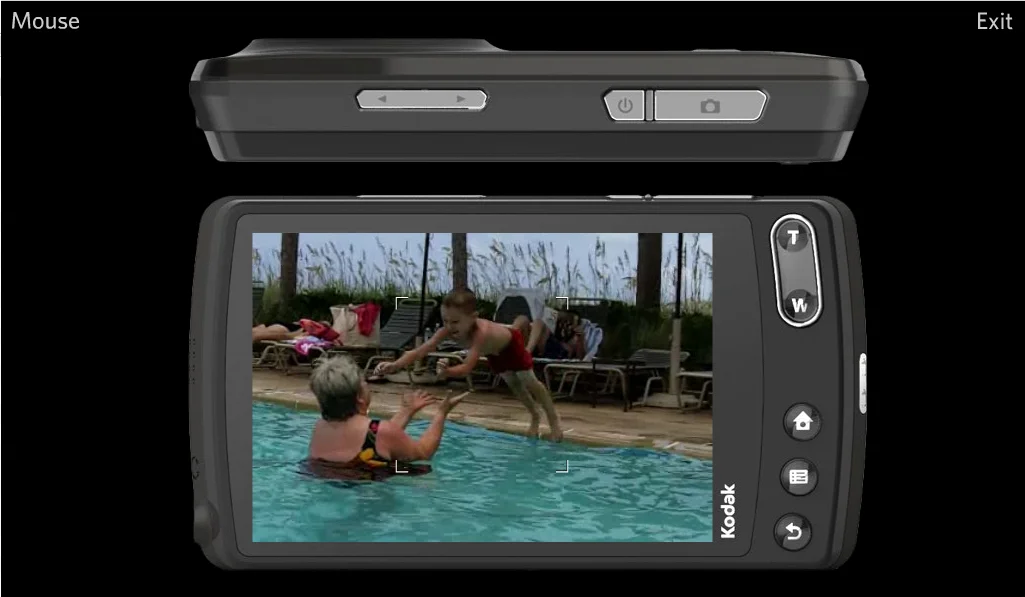
Across multiple digital camera programs, my responsibilities evolved alongside the products—spanning early concept development through validation and release. My work included UI design and interaction flow definition for new and enhanced camera functionality, as well as end-user research, usability testing, and validation to ensure intuitive operation across diverse user groups. These efforts balanced technical constraints, user needs, and business goals to deliver camera experiences that were both powerful and easy to use.
Graphic Communications Group & NexPress
In the early 2000s, Kodak expanded aggressively within the commercial printing industry, acquiring multiple companies with diverse technologies, interfaces, and visual languages. As part of the Graphic Communications Group and NexPress teams, I helped guide these newly acquired product lines toward a single, cohesive user experience and visual identity. My work focused on establishing consistent interaction patterns, interface standards, and design principles across printing equipment—ensuring usability, brand alignment, and a unified “Kodak look and feel” while respecting the unique workflows of professional print operators.


Digital Picture Frames
Supporting the product lines of consumer digital picture frames.